what strategies can you use to develop cultural competence
Mrs. Green leads the children in her preschool classroom in their morning time song: "The more we get together, together, together, the more we get together the hap—." She stops abruptly to run after Miles, who has left morn circle to play with the musical instruments. As Mrs. Green approaches him, Miles folds his artillery across his chest, and then kicks his legs and screams. Mrs. Green gently places her paw on Miles's arm and looks him in the middle. She says, "Miles, I run into that yous are upset because you don't want to sit at morning time circle and want to play with the musical instruments instead. Should we take the instruments to the circle and play with them after we've finished our calendar activities?" Miles smiles. Mrs. Greenish notes his response and says, "OK. Kickoff, please sit down calmly at morning circle for three minutes; and then you tin can play with the instruments. Is that a bargain?" Miles nods. Mrs. Green responds, "Give me a loftier-five!"
Miles's deportment are clearly a source of frustration for his teachers. Although teachers will want to evaluate whether they are planning activities that crave children to sit for an extended time and ensure that the activities they offer children are active and meaningful, it is besides important for teachers to empathise how to support children who showroom challenging behavior. Challenging behavior is defined as "any repeated pattern of behavior, or perception of behavior, that interferes with or is at take chances of interfering with optimal learning or date in prosocial interactions with peers and adults" (Powell, Dunlap, & Fox 2006, 26). Challenging beliefs tin signal difficulty with social and emotional adjustment—foundational competencies that are linked to children'south school readiness and later on school success (Fantuzzo et al. 2007).
Although challenging behavior tin can occur in whatsoever classroom, research indicates that some children in urban communities experience atmospheric condition that contribute to gamble factors for social and emotional delays (Play a joke on, Dunlap, & Powell 2002). In improver, there is a specific need to support children who live in poverty, as children in poor families are twice every bit likely to be at gamble for developmental, behavioral, and social delays as children in families earning 200 percent or more than of the federal poverty line (Children's Defense Fund 2014). That is, while 10–21 per centum of all preschool children show challenging behaviors such as assailment, noncompliance, defiance, tantrums, and belongings destruction, 30 percent of children who live in poverty exhibit such behaviors (Voorhees et al. 2013).
In this article nosotros describe v culturally responsive core strategies to promote positive instructor relationships with young children in preschool and minimize challenging beliefs: acquire most children and families, develop and teach expectations, take the child'southward perspective, teach and model empathy, and use group times to hash out disharmonize. As African American boys experience a much higher rate of suspensions and expulsions from preschool settings than practise other children (Gilliam 2005), these human relationship-edifice techniques are particularly relevant for teachers as they reflect on their own practices and biases—especially toward African American boys—in early childhood classrooms.
Learn about children and families
A core consideration in developmentally appropriate do and cultural responsiveness is that practitioners learn virtually each child and family and intentionally adapt and respond to each child's strengths and needs (Copple & Bredekamp 2009; Derman-Sparks & Edwards 2009). Culturally responsive exercise is ofttimes divers as using the experiences and perspectives of children and their families as a tool to support them more finer (Gay 2002). As this approach is child and family centered, it sets the stage for critical relationship building (Ford & Kea 2009).
Teachers can partner with families past inviting them to visit the classroom and participate in activities with their child. Teachers can also arrange to visit children at dwelling, where they may appoint in informal discussions with family members virtually what children enjoy doing for fun and learn about their favorite food, toy, or song. These interactions can reveal cultural values and norms in the home environment. Families may also share information almost their kid's temperament, primary play partners, and home language (NAEYC 1995). Meetings at school with families might accost family routines, religious holidays and traditions, and activities the families enjoy in the community. Teachers tin can apply information they larn most a child and family to support the child'south social and emotional adjustment to the early childhood surroundings. Further, these conversations can demonstrate that non all children and families inside a particular racial or ethnic group display similar characteristics, which is a potential teacher bias (Ford & Kea 2009). Sharing a short, warm chestnut with families, in person or in a annotation, about something their child did that day assures parents that the instructor cares most their child and makes an effort to know the kid individually. This further connects families to their kid's classroom community.
During a recent conversation with Miles's mother, Mrs. Green learned that Miles's father is a musician and that Miles actually enjoys music. Miles'southward mother explained that Miles likes to dance and sing to his favorite songs, moving vigorously effectually the house. Mrs. Green used her knowledge about Miles'due south interest to plan music and movement activities for future morning time circles to engage Miles.
Pyramid Model Framework
The five core strategies we suggest are informed by fundamental principles of the pyramid model (Play a trick on & Hemmeter 2009)—a comprehensive framework for addressing the social and emotional outcomes of young children (Hemmeter, Ostrosky, & Fox 2006). The pyramid model includes three levels of support: universal prevention strategies for use with all children; secondary social and emotional approaches for children at risk for social and emotional delays; and tertiary individualized and function-based interventions for children with persistent challenges (Fox & Hemmeter 2009).
Develop and teach expectations
The second culturally responsive strategy in the pyramid model framework is developing and teaching ii to five classroom expectations that are linked to the values and cultures of the children, teachers, and families. Expectations should be positively stated and developmentally appropriate, and should apply to both children and adults (teachers and families) (Steed & Pomerleau 2012). Later on cultivating a better understanding of children and families, early on childhood teachers can base expectations on shared values and connections to cultures. Young children should exist included in forming guidelines for beliefs, as they are more probable to empathise and follow them when they have input. Examples of expectations for preschool children include "Be a Friend, Exist Condom, and Exist a Helper" and "Use Listening Ears, Utilize Gentle Touches, and Apply Walking Feet."
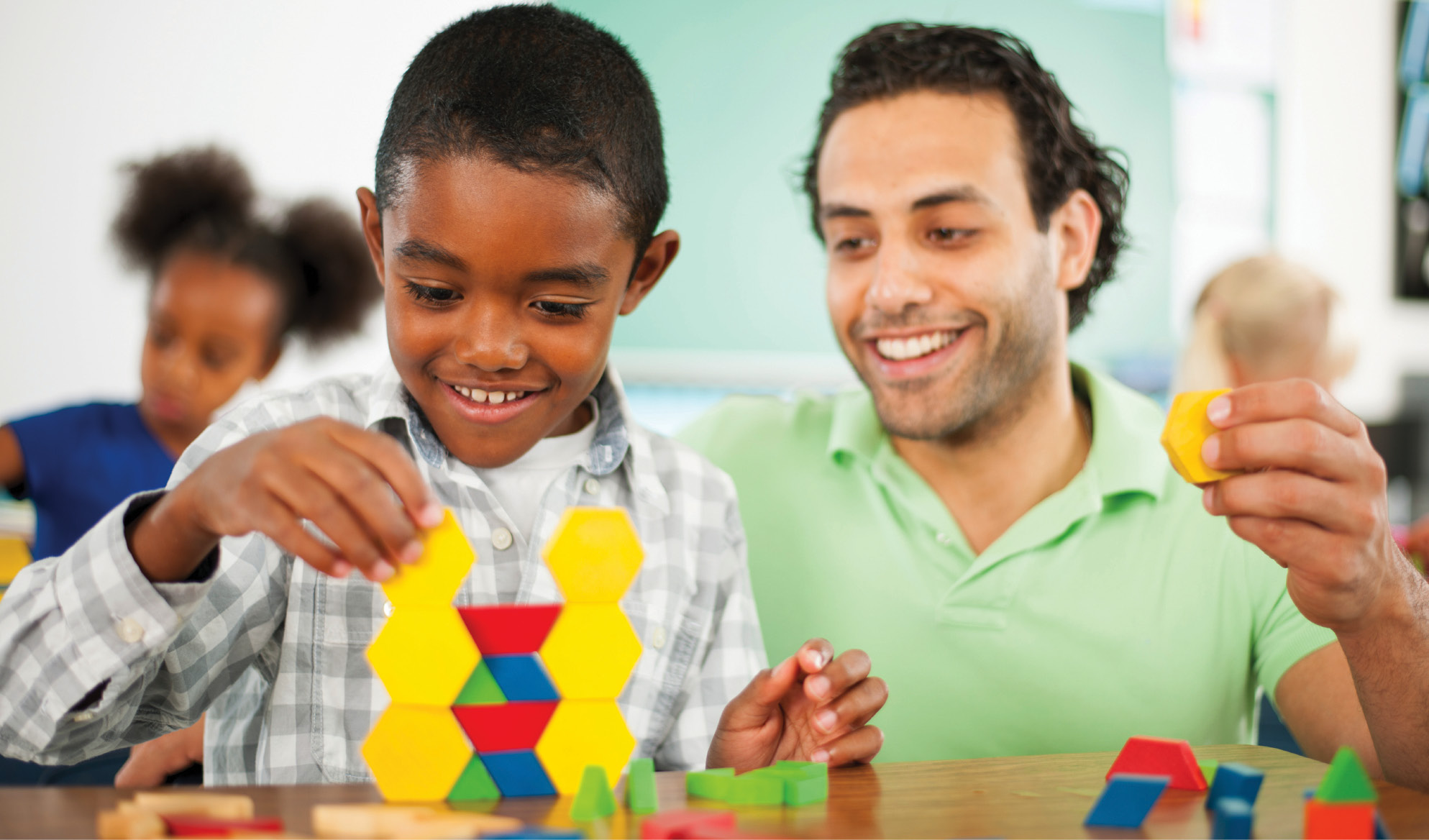 Expectations need to be consistently emphasized to prevent challenging behavior. In addition to responding to opportunities that arise during the day, teachers decide how and when they will teach, model, and positively reinforce the expectations across environments (circle time, music and movement activities, recess, luncheon/snack) and then that the guidelines and associated behaviors go part of the plan culture (Benedict, Horner, & Squires 2007). Many teachers develop songs and hand movements to go with their expectations. Other approaches include modeling, using puppets, reading stories, and role-playing. Pictures of the children, teachers, and staff demonstrating the expectations can be posted in classrooms and mutual areas for farther encouragement.
To reinforce positive behavior and to bring the deportment to children'due south attention, information technology is important to verbally acknowledge children and adults when they demonstrate expectations. When a child's beliefs reflects a great case of an expectation such as "Exist a Friend"—like helping another kid clean upwards a spill at lunch or inviting a new child to build a block belfry—teachers can write a note of thank you or give the kid an opportunity to article of clothing a "Super Friend" cape. A bulletin board in a common area provides a public place to post notecards recognizing adults who demonstrate examples of meeting program expectations ("Miss Wilma was a helper today when she fixed Erin's hearing device!").
To be culturally responsive, it is important that expectations reflect the values and cultures of families and teachers and other staff in the school. For example, in the African American civilisation, in which community is valued over independence (Ford & Kea 2009), guidelines for some activities (like snack) may emphasize relationship-building behaviors—passing the food bowl—over contained adaptive skills—taking an advisable portion of a cocky-serve snack.
Develop and teach empathy
Some other culturally responsive strategy for supporting positive relationships is empathy—concern for others arising from an emotional connection. Empathetic individuals utilise interpersonal sensitivity to empathise the experiences of others in order to provide support or help (Berliner & Materson 2015). Researchers have long theorized that empathy is a critical component in instructor effectiveness in urban settings, positively impacting teachers' dispositions in interactions with students of color (Warren 2014). Thus, it is important for teachers in urban settings to model and encourage empathy to foster a culturally responsive classroom environs.
To develop and teach empathy, teachers commencement have to know themselves (Derman-Sparks & Edwards 2009). It is necessary for teachers to engage in critical self-reflection to uncover implicit personal biases and assumptions, and bridge understanding across cultural groups (Cooper, He, & Levin 2011; Price 2015). Whether subconscious or explicit, teachers' negative perceptions about children who differ from them in terms of culture, race, or ethnic identity can affect the teachers' power to teach effectively and create compassionate classrooms.
Teachers can help children learn compassionate beliefs by modeling warm and responsive actions, like anticipating and responding promptly to children'due south needs and worries, and greeting children with a smile (Twardosz 2005). Using storybooks, games, and music is some other way to teach empathy. Teachers can create lessons and activities that highlight respect, kindness, compassion, and responsibility—and assistance children observe similarities with peers from different backgrounds (Berliner & Materson 2015). Teachers can ponder cogitating questions, such as, What are my initial reactions to this kid and her family?, What exercise my reactions tell me nearly my personal beliefs and assumptions?, and What can I do to build the child's and family's trust? (Collins, Arthur, & Wong-Wylie 2010; Price 2015). Although in that location is work to be done to unpack the contextual factors that may explicate why African American boys are expelled and suspended at a higher charge per unit than other preschool children, cocky-reflective questions like these and those offered throughout Anti-Bias Didactics for Young Children and Ourselves (Derman Sparks & Edwards 2009) are one place to start.
It is necessary for teachers to engage in disquisitional self-reflection to uncover implicit personal biases and assumptions.
Historically, picture books have featured more often than not white characters (Larrick 1965). When choosing high-quality books for the classroom, make sure that the characters reflect the ethnic makeup of your classroom (Larrick 1965; Koss 2014), equally it is important for all children, and particularly those of color, to "see themselves" in books. During these lessons, teachers can teach relevant emotion vocabulary (Joseph, Strain, & Ostrosky 2008), read books, and sing songs that reflect the children's cultures. According to the tenets of Afrocentric teaching—which harnesses the skills African American children bring to schools to appoint them in the classroom experience (Ford & Kea 2009)—combining music with artistic movement, mime, and trip the light fantastic is a form of expression for many African American children and engages them in shared melancholia experiences that are useful for empathy development (Boykin 1994; Laird 2015).
For example, in a jubilant rendition, Miles and Carmen share a toy pulsate and a tambourine as they trip the light fantastic to a pop song heard in their communities. The song promotes unity, friendship, and honey. Through group music making, children can express feelings and connect with the feelings of others, promoting positive social and emotional evolution.
Additional Resources
Center for the Social and Emotional Foundations for Early on Learning (CSEFEL)— http://csefel.vanderbilt.edu
Technical Help Center on Social Emotional Intervention (TACSEI)— http://challengingbehavior.fmhi.usf.edu
Pyramid Model Consortium—world wide web.pyramidmodel.org
Perspective taking
A fourth culturally responsive strategy, perspective taking, has been defined as the capacity to sympathise another's thoughts, feelings, or internal states (DeBernardis, Hayes, & Fryling 2014). Through the use of affective statements, teachers tin can reframe a child'south challenging behavior and focus on the child's internal state. Affective statements are "I" statements that limited a feeling, precisely describe a child's behavior, and make the child aware of the positive or negative impact of the behavior (Costello, Wachtel, & Wachtel 2009). Take, for case, a kid who often transitions from luncheon to outdoor time by pushing his way through classmates to discard his trash and nuance to the playground door. A teacher might say, "Stop running in the classroom. When you run in the classroom, our friends are non safe." To reframe the child'southward beliefs, the instructor might consider that the child is excited to play exterior. From this perspective, the instructor could rephrase her statement: "I run into that you are really excited about going outside. Thank you for putting your dish in the trash, but delight remember to use your walking feet and move around your friends." When teachers use affective statements to reframe a child'south challenging behavior, it demonstrates their understanding of the child'due south perspective. Miles's instructor used an affective statement that considered his perspective about morning time circle when she stated, "Miles, I see that you are upset considering you lot do not want to sit at morning circle and want to play with the musical instruments instead."
Using group fourth dimension to hash out conflict
The concluding culturally responsive strategy drawing from the pyramid model framework is using grouping time to resolve disharmonize. This allows for a restorative justice approach, which offers those involved in the conflict an opportunity for reconciliation. Although many children benefit from the use of group time to address conflict and this arroyo can promote inclusion, equally opposed to exclusion (e.thou., time out), as a response to challenging behavior, it is important to develop methods and awareness so children do not feel shamed during the process but rather office of a trusting community of trouble solvers. When done well, problem solving equally a group can foster active engagement and learning and enable children and adults to build potent relationships. The teacher tin can institute the tone for the group by reading a poem about friendship or sharing a culturally relevant and familiar quote from a song, picture show, or book. Next, it is helpful to remind children of the expectations for the discussion: "Nosotros've been practicing how to listen and how to talk at group time. Let's call back to wait calmly for our turn to speak, brand eye contact with the person to whom nosotros're talking, and employ kind words." In some cases, teachers can minimize challenging behavior by conducting group fourth dimension prior to situations with potential for challenging beliefs (before a field trip, in the first of the school year, prior to implementing a change to the environment) (Costello, Wachtel, & Wachtel 2009; Pautz 2009).
Determination
Young children with challenging behavior are ofttimes rejected by their peers and receive less positive feedback from teachers than their peers practise (Hemmeter, Ostrosky, & Fox 2006). Early babyhood classrooms are a primary setting for educational activity skills that are critical for immature children's social and emotional development. Given the large amount of time many children spend in these settings, information technology is important that strong, positive teacher–kid relationships be nurtured to ensure that children receive the support needed to promote positive social and emotional development (Bronfenbrenner 1977) and school readiness in general (Williford et al. 2013). Practitioners in urban settings play a valuable role in immature children's social and emotional development by providing supports that are relevant and appropriate.
The five culturally responsive strategies described in this article tin guide teachers in creating a classroom atmosphere that non only responds to children's challenging behaviors but also anticipates their needs. Implementation of these strategies helps teachers initiate sustainable relationships and nurturing classrooms where all children are valued and have opportunities to abound and develop. The more children go together and appoint in prosocial interactions with teachers and peers, the happier everyone will truly be.
References
Benedict, E.A., R.H. Horner, & J.K. Squires. 2007. "Cess and Implementation of Positive Behavior Support in Preschools." Topics in Early Babyhood Special Education 27 (iii): 174–92.
Berliner, R., & T.L. Masterson. 2015. "Review of the Research: Promoting Empathy Development in the Early Childhood and Elementary Classroom." Childhood Education 91 (1): 57–64.
Boykin, A.Westward. 1994. "Afrocultural Expression and Its Implications for Schooling." In Instruction Diverse Populations: Formulating a Knowledge Base, eds. E.R. Hollins, J.E. King, & W.C. Hayman, 243–56. Albany: State University of New York Press.
Bronfenbrenner, U. 1977. "Toward an Experimental Ecology of Human Development." American Psychologist 32 (seven): 515–31.
Children's Defence force Fund. 2014. The State of America'south Children. Washington, DC: Children's Defense Fund. www.childrensdefense.org/library/state-of-americas-children/2014-soac.pdf.
Collins, Southward., North. Arthur, & K. Wong-Wylie. 2010. "Enhancing Reflective Do in Multicultural Counseling Through Cultural Auditing." Periodical of Counseling and Development 88 (iii): 340–47.
Cooper, J.E., Y. He, & B.B. Levin. 2011. Developing Disquisitional Cultural Competence: A Guide for 21st Century Educators. Thousand Oaks, CA: Sage.
Copple, C., & South. Bredekamp, eds. 2009. Developmentally Appropriate Practice in Early Childhood Programs Serving Children From Nativity Through Historic period eight. tertiary ed. Washington, DC: National Association for the Education of Young Children.
Costello, B., J. Wachtel, & T. Wachtel. 2009. The Restorative Practices Handbook for Teachers, Disciplinarians, and Administrators. Bethlehem, PA: International Institute for Restorative Practices.
DeBernardis, One thousand.M., L.J. Hayes, & Thou.J. Fryling. 2014. "Perspective Taking as a Continuum." Psychological Record 64 (1): 123–31.
Derman-Sparks, 50., & J.O. Edwards. 2009. Anti-Bias Education for Young Children and Ourselves. Washington, DC: National Association for the Education of Young Children.
Dixon, H. 2016. "Making Peace in Kindergarten: Social and Emotional Growth for All Learners." Young Children 71 (4): 57–66. world wide web.naeyc.org/yc/pastissues.
Fantuzzo, J., R. Bulotsky-Shearer, P. McDermott, C. McWayne, D. Frye, & S. Perlman. 2007. "Investigation of Dimensions of Social-Emotional Classroom Beliefs and School Readiness for Low-Income Urban Preschool Children." Schoolhouse Psychology Review 36 (1): 44–62.
Ford , D.Y., & C.D. Kea. 2009. "Creating Culturally Responsive Pedagogy: For Students' and Teachers' Sakes." Focus on Exceptional Children 41 (9): ane–sixteen.
Fox, L., G. Dunlap, & D. Powell. 2002. "Young Children With Challenging Behavior: Problems and Considerations for Behavior Support." Journal of Positive Behavior Interventions 4 (four): 208–17.
Play a joke on, L., & 1000.L. Hemmeter. 2009. "A Program-Wide Model for Supporting Social Emotional Development and Addressing Challenging Behavior in Early Babyhood Settings." In Handbook of Positive Behavior Support, eds. W. Sailor, G. Dunlap, Thou. Sugai, & R. Horner, 177–202. New York: Springer.
Gay, G. 2002. "Preparing for Culturally Responsive Education." Periodical of Teacher Education 53 (2): 106–16.
Gilliam, West.Southward. 2005. Prekindergartners Left Backside: Expulsion Rates in the State in Prekindergarten Programs. New Haven, CT: Yale Academy Child Study Center.
Hemmeter, G.L., G.M. Ostrosky, & L. Fox. 2006. "Social and Emotional Foundations for Early on Learning: A Conceptual Model for Intervention." Schoolhouse Psychology Review 35 (4): 583–601.
Joseph, G., P. Strain, & Chiliad.Grand. Ostrosky. 2008. Fostering Emotional Literacy in Immature Children: Labeling Emotions. What Works Brief #21. Champaign, IL: Center on the Social and Emotional Foundations of Learning. http://csefel.vanderbilt.edu/kits/wwbtk21.pdf.
Koss, K. 2014. "Diversity in Contemporary Picture Books: A Content Assay." Journal of Children'due south Literature 41 (ane): 32–42.
Laird, Fifty. 2015. "Empathy in the Classroom: Can Music Bring Us More in Melody With One Another?" Music Educators Journal 101 (4): 56–61.
Larrick, N. 1965. "The All-White World of Children's Books." Saturday Review (1): 63–65.
NAEYC (National Association for the Education of Young Children). 1995. "Responding to Linguistic and Cultural Diversity. Recommendations for Effective Early Childhood Education." Position statement. Washington DC: NAEYC. https://world wide web.naeyc.org/files/naeyc/file/positions/PSDIV98.PDF.
Pautz, Chiliad.-I. 2009. "Empowering the Next Generation: Restorative Practices in a Preschool." Restorative Practices EForum. www.iirp.edu/iirpWebsites/web/uploads/article_pdfs/93908_rp_preschool.pdf.
Powell, D., G. Dunlap, & Fifty. Fox. 2006. "Prevention and Intervention for the Challenging Behaviors of Toddlers and Preschoolers." Infants and Young Children nineteen (ane): 25–35.
Toll, C. 2015. "Reflective Questions for Early on Interventionists and Early Babyhood Special Educators." Presentation at the Annual International Conference of the Division for Early Babyhood of the Council for Infrequent Children, in Atlanta, Georgia.
Steed, East.A., & T. Pomerleau. 2012. Preschool-Broad Evaluation Tool (PreSet) Manual, Enquiry Edition: Assessing Universal Plan-Wide Positive Behavior Support in Early Childhood. Baltimore, Dr.: Brookes.
Twardosz, S. 2005. Expressing Warmth and Amore to Children. What Works Brief #20. Nashville, TN: Center on the Social and Emotional Foundations for Early on Learning. http://csefel.vanderbilt.edu/briefs/wwb20.pdf.
Voorhees, M.D., L.V. Walker, Chiliad.E. Snell, & C.G. Smith. 2013. "A Demonstration of Individualized Positive Behavior Support Interventions by Caput Start Staff to Address Children's Challenging Behavior." Research and Practice for Persons With Severe Disabilities 38 (3): 173–85.
Warren, C.A. 2014. "Towards a Pedagogy for the Application of Empathy in Culturally Diverse Classrooms." Urban Review 46 (iii): 395–419.
Williford, A.P., M.F. Maier, J.T. Downer, R.C. Pianta, & C. Howes. 2013. "Understanding How Children's Appointment and Teachers' Interactions Combine to Predict School Readiness." Journal of Applied Developmental Psychology 34 (vi): 299–309.
vanallencalle1951.blogspot.com
Source: https://www.naeyc.org/resources/pubs/yc/nov2016/culturally-responsive-strategies
0 Response to "what strategies can you use to develop cultural competence"
Post a Comment