Never Again Will We Be Slaves
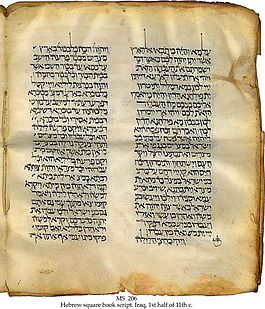
11th-century manuscript of the Hebrew Bible with Targum, Exodus 12:25-31

The Franks Casket is an eighth-century Anglo-Saxon whalebone catafalque, the back of which depicts the enslavement of the Jewish people at the lower right.
The Bible contains many references to slavery, which was a mutual do in antiquity. Biblical texts outline sources and the legal status of slaves, economic roles of slavery, types of slavery, and debt slavery, which thoroughly explain the institution of slavery in Israel in artifact.[ane] The Bible stipulates the treatment of slaves, especially in the Old Testament.[2] [3] [4] In that location are also references to slavery in the New Attestation.[five] [vi]
Many of the patriarchs portrayed in the Bible were from the upper echelons of society and the owners of slaves and enslaved those in debt to them, bought their fellow citizens' daughters as concubines, and perpetually enslaved foreign men to piece of work on their fields.[7] Masters were men, and it is not evident that women were able to ain slaves until the Elephantine papyri in the 400s BC.[7] Other than these instances, information technology is unclear whether or not land-instituted slavery was an accepted practice.
Information technology was necessary for those who owned slaves, specially in large numbers, to be wealthy considering the masters had to pay taxes for Jewish and non-Jewish slaves because they were considered part of the family unit of measurement. The slaves were seen equally an important function of the family's reputation, particularly in Hellenistic and Roman times, when the slave companions for a woman were seen as a manifestation and protection of a woman's accolade.[seven] As time progressed, domestic slavery became more than prominent, and domestic slaves, normally working as an banana to the wife of the patriarch, allowed larger houses to run more smoothly and efficiently.[7]
In the 19th century U.s.a., abolitionists and defenders of slavery debated the Bible's bulletin on the topic.[8] [9] Abolitionists used texts from both the Old and New Testaments to argue for the manumission of slaves, and against kidnapping or "stealing men" to own or sell them as slaves.[10] [eleven]
Slavery in antiquity [edit]
Slaves had a variety of different purposes. To determine the function, many scholars await at repetitive descriptions in texts that were written effectually the same fourth dimension and reports of other cultures from the well-documented Greco-Roman culture.[7] One of the main functions of slaves was equally status symbols for the upper members of gild, especially when information technology came to dowries for their daughters. These slaves could be sold or given away as needed, but also showed that the family unit was capable of providing generous amounts for their daughters to be married off. They too catered to the needs of the temple and had more than domestic abilities such as keeping up the household and raising farm animals and small amounts of crops. Masters often took advantage of their slaves being at their brook and call by requiring them to perform duties in public that the master had the power to do himself. This showed a level of luxury which extended across the individual sphere into the public.[7] In addition to showing luxury, possession of slaves was necessary for a adept family unit background, and many wealthy men viewed their colleagues who possessed only few slaves as the type of individual who needed to be pitied.[7]
Old Testament [edit]
War captives [edit]
The Israelites did non by and large get involved in distant or large-calibration wars, and apparently capture was not a meaning source of slaves.[12]
The taking of female captives is encouraged past Moses in Numbers 31. After being instructed by Yahweh to accept vengeance upon the Midianites, Moses tells the Israelites to kill the male person children and nonvirgin females only have the immature virgins for themselves.[13] Kent Brown at Whitworth University claims that since the army did not receive a direct instruction by Yahweh to accept the virgin girls captive, this cannot be justified as the obeying of a divine gild; rather the Israelites enslaved the virgin women of their own initiative.[14]
In the Deuteronomic Code, enemy nations that surrendered to the Israelites were to serve as tributaries. However, if they decided to state of war against Israel, all the men were to be killed and all the women and children were to be considered spoils of state of war.[15]
If the soldier desired to marry a captured foreigner he was to take her home to his house, shave her caput, pare her nails, and discard her captive'south garb. She would remain in his house a total calendar month, mourning for her father and female parent, after that he could go in to her and be her husband, and she be his wife. If he later wished to stop the relationship, he could not sell her into slavery.[16]
Harold C. Washington of the Saint Paul School of Theology cites Deuteronomy 21:10-xiv every bit an case of how the Bible condones sexual violence committed by Israelites; they were taking advantage of women who, as war captives, had no recourse or means of cocky defence.[17]
M.I. Rey at the Graduate Constitute of Religious Studies at Boston University argues that the passage is an endorsement of non only sexual slavery simply genocidal rape, as the capture of these women is justified on the grounds of their not being Hebrew. Rey farther argues that these women were not viewed as equals to Hebrew women, but rather every bit war trophies, and thus their captors had no qualms in engaging in sexual violence.[18] However, the biblical command never specifies that the war in question is against non-Hebrews, but rather confronting generic "enemies", a term used in reference to Israelites as well equally foreigners,[19] and several wars between Israelite armies are recorded in the Bible.[twenty]
According to many Jewish commentators, the laws of the captive woman are not intended to encourage capture and forced marriage of women, but rather view it as inevitable in wartime and seek to minimize its occurrence and brutality.[21] [22] Past this view, the laws of Deuteronomy 21:12-thirteen (that the convict woman must shave her caput, spend a month in mourning, etc. before marriage) are intended "to remove [the captor'southward] desire for her, so that he not take her as married woman".[23]
Fugitive slaves [edit]
The Deuteronomic Code forbids the Israelites from handing over fugitive slaves to their masters or oppressing them, and instructs that these fugitives should be allowed to reside where they wish.[24] Although a literal reading would indicate that this applies to slaves of all nationalities and locations, the Mishnah and many commentators consider the rule to take the much narrower application, to just those slaves who flee from outside Israelite territory into information technology.[25] [26]
Blood slavery [edit]
It was also possible to exist born into slavery.[27] If a male Israelite slave had been given a wife by his owner, then the wife and whatsoever children which had resulted from the matrimony would remain the belongings of his owner, according to the Covenant Lawmaking.[28] Although no nationality is specified, 18th-century theologians John Gill (1697–1771) and Adam Clarke suggested this referred simply to Canaanite concubines.[29] [30]
Debt slavery [edit]
Similar the rest of the Aboriginal Well-nigh East, the legal systems of the Israelites divided slaves into unlike categories: "In determining who should benefit from their intervention, the legal systems drew two important distinctions: between debt and chattel slaves, and betwixt native and foreign slaves. The authorities intervened get-go and foremost to protect the old category of each--citizens who had fallen on hard times and had been forced into slavery past debt or famine."[31]
Poverty, and more more often than not a lack of economic security, compelled some people to enter debt chains. In the Ancient Near E, wives and (non-adult) children were dependents of the head of household and were sometimes sold into slavery by the married man or begetter for financial reasons. Evidence of this viewpoint is plant in the Code of Hammurabi, which permits debtors to sell their wives and children into temporary slavery, lasting a maximum of 3 years. The book of Leviticus besides exhibits this, allowing foreign residents to sell their ain children and families to Israelites, although no limitation is placed on the elapsing of such slavery.[32] Biblical authors repeatedly criticize debt slavery, which could be attributed to loftier revenue enhancement, monopoly of resources, high-involvement loans, and collapse of college kinship groups.[7]
Debt slaves were one of the ii categories of slaves in ancient Jewish society. As the name implies, these individuals sold themselves into slavery in order to pay off debts they may have accrued.[i] These individuals were not permanently in this state of affairs and were unremarkably released after six to vii years. Chattel slaves, on the other hand, were less mutual and were normally prisoners of war who retained no private right of redemption. These chattel slaves engaged in full-time menial labor, frequently in a domestic capacity.[ane]
The earlier[33] [34] [35] [36] Covenant Code instructs that, if a thief is defenseless afterwards sunrise and is unable to make restitution for the theft, and so the thief should be enslaved.[37]
Marriage To slaves [edit]
Marriage with slaves was non unheard of or prohibited.These female slaves were treated more like women than slaves which may have resulted, according to some scholars, due to their sexual role, which was particularly to "breed" more than slaves.
Being sold to be a married woman was common in the ancient world. Throughout the Old Testament, the taking of multiple wives is recorded many times.[38] [39] An Israelite father could sell his single daughters into servitude, with the expectation or agreement that the master or his son could somewhen marry her (every bit in Exodus 21:7-11.) It is understood past Jewish and Christian commentators that this referred to the sale of a daughter, who "is not arrived to the historic period of twelve years and a day, and this through poverty."[forty]
And if a human sells his daughter to be a slave, she shall not get out as the male slaves exercise. If she does not please her main, who has betrothed her to himself, and then he shall let her exist redeemed. He shall take no right to sell her to a strange people, since he has dealt deceitfully with her. And if he has betrothed her to his son, he shall bargain with her according to the custom of daughters. If he takes some other wife, he shall non diminish her nutrient, her habiliment, and her marriage rights. And if he does not exercise these three for her, and so she shall get out free, without paying money.
The code also instructs that the woman was to be immune to exist redeemed[41] if the human being broke his betrothal to her. If a female person slave was matrimonial to the main'southward son, so she had to be treated as a normal daughter. If he took another married woman, so he was required to go along supplying the aforementioned amounts of food, habiliment, and conjugal rights to her.[42] The code states that failure to comply with these regulations would automatically grant gratis manumission to the enslaved adult female,[43] while all Israelite slaves were to exist treated equally hired servants.[44]
The betrothal clause seems to have provided an exception to the constabulary of release in Deuteronomy fifteen:12 (cf. Jeremiah 34:fourteen), in which both male person and female Israelite servants were to be given release in the seventh year.[45]
The penalty if an Israelite engaged in sexual activity with an unredeemed female slave who was betrothed was that of scourging, with Jewish tradition seeing this as only referring to the slave,[46] [47] (versus Deuteronomy 22:22, where both parties were stoned, being free persons), as well as the human confessing his guilt and the priest making atonement for his sin.[48]
Permanent enslavement [edit]
As for Israelite slaves, the Covenant Code allows them to voluntarily renounce their seventh-year manumission and become permanent slaves (literally existence slaves forever).[49] The Law require that the slaves confirmed this desire "earlier God",[49] a phrase which has been understood to mean at either a religious sanctuary,[50] [51] before judges,[52] or in the presence of household gods.[53] Having washed this, slaves were so to have an awl driven through their ear into a doorpost by their master.[49] This ritual was mutual throughout the Ancient Virtually E, beingness adept by Mesopotamians, Lydians, and Arabs;[53] in the Semitic world, the ear symbolised obedience (much as the heart symbolises emotion, in the modern western world), and a pierced earlobe signified servitude.
Slave trade [edit]
The Holiness code of Leviticus explicitly allows participation in the slave merchandise,[54] with not-Israelite residents who had been sold into slavery existence regarded every bit a type of property that could be inherited.
Working conditions [edit]
The Ten Commandments make clear that honouring the Shabbat was expected of slaves, not just their masters.[55] The afterwards[34] [35] [36] The book of Deuteronomy, having repeated the Shabbat requirement, also instructs that slaves should be allowed to celebrate the Sukkot festival.[56]
Leviticus instructs that during the Sabbatical Year, slaves and their masters should eat food which the state yields, without beingness farmed.[57] This commandment not to work the state is directed at the landowner and does not mention slaves, but other verses imply that no produce is sown by anyone in this year,[57] and command that the land must "lie fallow".[58] It is not mentioned whether slaves receive residuum from not-agricultural piece of work during this year.
Different the other books, Leviticus does not mention the freeing of Israelite slaves after vi years, instead merely giving the vague instruction that Israelite slaves should not to be compelled to work with rigour;[59] Maimonides argues that this was to be interpreted equally forbidding open-ended work (such as go on doing that until I come dorsum), and that disciplinary action was non to include instructing the slave to perform otherwise pointless piece of work.[34] [60]
A special case is that of the debtor who sells himself equally a slave to his creditor; Leviticus instructs that in this state of affairs, the debtor must not be made to practise the work of slaves, merely must instead be treated the same as a hired servant.[61] In Jewish tradition, this was taken to mean that the debtor should non be instructed to practise humiliating piece of work - which only slaves would do - and that the debtor should be asked to perform the craft(south) which they unremarkably did earlier they had been enslaved, if it is realistic to do so.[34] [sixty]
Injury and compensation [edit]
The earlier[34] [35] [36] Covenant Code provides a potentially more than valuable and direct course of relief, namely a degree of protection for the slave's person (their body and its health) itself. This codification extends the bones lex talionis (....eye for an eye, tooth for a tooth...),[62] to hogtie that when slaves are significantly injured by their masters, manumission is to be the compensation given; the canonical examples mentioned are the knocking out of an middle or a tooth.[63] This resembles the earlier Lawmaking of Hammurabi, which instructs that when an injury is washed to a social inferior, monetary compensation should be fabricated, instead of carrying out the basic lex talionis; Josephus indicates that past his time it was adequate for a fine to be paid to the slave, instead of manumitting them, if the slave agreed.[64] Nachmanides argued that information technology was a biblically commanded duty to liberate a slave who had been harmed in this way.[34]
The Hittite laws and the Code of Hammurabi both insist that if a slave is harmed by a third party, the third party must financially compensate the possessor.[65] In the Covenant Lawmaking, if an ox gores a slave, the ox owner must pay the servant'south master a 30 shekel fine.[66]
The murder of slaves by owners was prohibited in the Law covenant. The Covenant Code conspicuously institutes the death sentence for beating a gratuitous homo to death;[67] in contrast, beating a slave to death was to be avenged but if the slave does not survive for one or two days after the beating.[68] Abraham ben Nathan of Lunel, a 12th-century Provençal scholar, Targum, and Maimonides contend that avenged implies the death penalty,[34] [60] merely more than recent scholars view information technology as probably describing a bottom punishment.[69] A number of modern Protestant Bible versions (such as the New Living Translation, New International Version and New Century Version) translate the survival for 1 or two days every bit referring to a full and speedy recovery, rather than to a lingering death, as favoured by other contempo versions (such as the New Revised Standard Version, and New American Bible).
Manumission [edit]
In a parallel with the shmita organization the Covenant Lawmaking prescribes automated manumission of male Israelite slaves after they have worked for six years;[seventy] this excludes non-Israelite slaves, and specifically excludes Israelite daughters, who were sold into slavery by their fathers, from such automatic 7th-yr manumission. Such were bought to exist matrimonial to the owner, or his son, and if that had non been washed, they were to be allowed to be redeemed. If the wedlock took place, they were to be set up costless if her husband was negligent in his basic marital obligations.[71] The afterwards[34] [35] [36] Deuteronomic Lawmaking is seen by some to contradict[34] elements of this instruction, in extending automated seventh year manumission to both sexes.[72]
The Deuteronomic Code as well extends[73] the seventh-year manumission dominion by instructing that Israelite slaves freed in this way should be given livestock, grain, and wine, as a departing souvenir;[74] the literal meaning of the verb used, at this indicate in the text, for giving this gift seems to be hang round the neck.[34]The Gift is described in The 1901 Jewish Encyclopedia as representing a gift of produce rather than of money or article of clothing;[34] many Jewish scholars estimated that the value of the three listed products was about 30 shekels, and so the gift gradually came to be standardised as produce worth this fixed value.[75] The Bible states that ane should not regret freeing the Slave, for slaves were worth Twice the Hired mitt to The Master;[76] Nachmanides enumerates this equally a command rather than merely equally a piece of advice.[34]
According to Jeremiah 34:8–24, Jeremiah also demanded that King Zedekiah manumit (free) all Israelite slaves (Jeremiah 34:nine). Leviticus does not mention seventh-year manumission; instead it merely instructs that debt-slaves, and Israelite slaves endemic past foreign residents, should be freed during the national Jubilee[3] (occurring either every 49 or every fifty years, depending on interpretation).[53]
While many commentators see the Holiness Code regulations every bit supplementing the prior legislation mandating manumission in the seventh twelvemonth,[77] [78] [79] the otherwise potentially long wait until the Jubilee was somewhat alleviated by the Holiness Lawmaking, with the didactics that slaves should be immune to purchase their freedom by paying an amount equal to the total wages of a hired servant over the unabridged period remaining until the next Jubilee (this could be up to 49 years-worth of wages). Claret relatives of the slave were also allowed to buy the slave'south freedom, and this became regarded as a duty to be carried out by the next of kin (Hebrew: Become'el).[80]
In the Old Testament, the differences betwixt male and female enslavement were vast. Deuteronomic code practical more often than not to men, while women were able to be subjected to a much different type of slavery. This alter in status would crave a female debt slave to become a permanent fixture of the household by manner of marrying the father or the father's son. Deuteronomy 21:9 states that the female person slave must be treated as a daughter if such permanent condition is to be established.[81]
Abolition of slavery [edit]
According to the Jewish Encyclopedia, the slavery of Israelites was abolished by the prophets after the destruction of the Temple of Solomon.[82] The prophet Nehemiah rebuked the wealthy Israelites of his day for continuing to own Israelite slaves.[83]
New Testament [edit]
Slavery is mentioned numerous times in the New Testament. The word "servant" is sometimes substituted for the give-and-take "slave" in English translations of the Bible.
Gospels [edit]
The Bible says that Jesus healed the sick slave of a centurion[84] and restored the cut off ear of the high priest'south slave.[85] In his parables, Jesus referenced slavery: the prodigal son,[86] ten aureate coins,[87] unforgiving tenant,[88] and tenant farmers.[89] Jesus' didactics on slavery: spiritual slavery,[xc] a slave having 2 masters (God and mammon),[91] slavery to God,[92] acting every bit a slave toward others,[93] and the greatest among his disciples existence the least of them.[94] Jesus likewise taught that he would give burdened and weary laborers rest.[95] The Passion narratives are interpreted past the Catholic Church as a fulfillment of the Suffering Servant songs in Isaiah.[96]
Jesus' view of slavery compares the relationship between God and humankind to that of a primary and his slaves. 3 instances where Jesus communicates this view include:
Matthew xviii:21-35: Jesus' Parable of the Unmerciful Servant, wherein Jesus compares the relationship betwixt God and humankind to that of a master and his slaves. Jesus offers the story of a chief selling a slave along with his married woman and children.
Matthew 20:20-28: A series of remarks wherein Jesus recognizes it is necessary to be a slave to exist "first" among the deceased entering heaven.
Matthew 24:36-51: Jesus' Parable of the Faithful Retainer, wherein Jesus once more compares the relationship betwixt God and humankind to that of a master and his slaves.
Epistles [edit]
In Paul's letters to the Ephesians, Paul motivates early on Christian slaves to remain loyal and obedient to their masters similar they are to Christ. Ephesians vi:v-8 Paul states, "Slaves, be obedient to your human masters with fear and trembling, in sincerity of center, as to Christ" which is Paul instructing slaves to obey their master.[97] Similar statements regarding obedient slaves can be establish in Colossians 3:22-24, 1 Timothy 6:1-2, and Titus 2:9-10.[98] [99] [100] In Col four:1 Paul advises members of the church, who are slave masters, to "treat your slaves justly and fairly, realizing that you too accept a Principal in heaven."[101] Adding to Paul's advice to masters and slaves, he uses slavery as a metaphor. In Romans 1:1 Paul calls himself "a slave of Christ Jesus" and subsequently in Romans six:18 Paul writes "Y'all have been set up free from sin and become slaves to righteousness."[102] [103] Also in Galatians, Paul writes on the nature of slavery within the kingdom of God. Galatians 3:27-29 states "there is neither slave nor free person, at that place is not male and female person; for yous are all one in Christ Jesus."[104] We find similar patterns of spoken communication and agreement about slavery in Peter'due south epistles. In 1 Peter ii:18, Saint Peter writes "Slaves, be field of study to your masters with all reverence, non but to those who are skilful and equitable but also to those who are perverse."[105] In ane Timothy 1:10, Paul condemns enslavers with the sexually immoral, abusers of themselves with mankind, enslavers, liars, perjurers, and whatever else is contrary to audio doctrine.
Philemon [edit]
The Epistle to Philemon has go an important text in regard to slavery; information technology was used past pro-slavery advocates besides every bit by abolitionists.[106] [107] In the epistle, Saint Paul writes to Saint Philemon that he is returning Saint Onesimus, a avoiding slave, dorsum to him; however, Paul besides entreats Philemon to regard Onesimus, who he says he views as a son, not every bit a slave just as a beloved brother in Christ. Philemon is requested to treat Onesimus every bit he would care for Paul.[108] According to Cosmic tradition, Philemon freed Onesimus.[109]
Manumission [edit]
The prospect of manumission is an thought prevalent within the New Attestation. In contrast to the Onetime Testament, the New Testament'south criteria for manumission encompasses Roman laws on slavery as opposed to the shmita arrangement. Manumission within the Roman organisation largely depends on the mode of enslavement: slaves were ofttimes foreigners, prisoners of state of war, or those heavily indebted. For foreign-born individuals, manumission was increasingly amorphous; nevertheless, if subject to debt slavery, manumission was much more concrete: freedom was granted in one case the debt was paid. Children were oft offered to creditors as a form of payment and their manumission was determined ab initio(at the outset) with the pater(family head).[81] This manicipia(enslavement) of children by the pater did not exclude the selling of children into sexual slavery. If sold into sex slavery, the prospect of consummate manumission became much less likely under the stipulations of Roman Law. existence sold into sexual slavery meant greater gamble of perpetual servitude, by way of explicit enslavement or forced marriage.
One of the first discussions of manumission in the New Attestation can be seen in Paul's interaction with Philemon'southward slave Onesimus. Onesimus was held convict with Paul, as he was a fugitive, run-away slave. Paul proceeds to baptize the slave Onesimus, and then writes to his owner, Philemon, telling him that he volition pay any fee Onesimus owes for his fugitive condition. Paul does not explicitly enquire Philemon for Onesimus'south manumission; withal, the offer a "fee" for Onesimus's escape has been discussed every bit a possible latent form of manumission.[110] Paul's treatment of Onesimus additionally brings into question of Roman slavery as a "closed" or "open up" slave arrangement. Open slave systems let for incorporation of freed slaves into society subsequently manumission, while closed systems manumitted slaves still lack social agency or social integration.[110] Roman slavery exhibited characteristics of both, open and closed, systems which farther complicates the letter of the alphabet from Paul to Philemon regarding the slave Onesimus.
In the fourth dimension of the New Testament, at that place were three modes in which a slave could be manumitted by his or her master: a will could include a formal permission of manumission, a slave could be declared free during a census, or a slave and master could get before a provincial official.[110] These modes of manumission lend evidence to suggest that manumission was an everyday occurrence, and thus complicates New Attestation texts encouraging manumission. In ane Corinthians seven:21, Paul encourages enslaved peoples to pursue manumission; however, this manumission could be connoted in the boundaries of a closed slave arrangement in which manumission does not equate to complete freedom.[110] Modes of manumission, in the New Testament, are one time again disputed in a letter from Paul to Galatians in which Paul writes "For freedom Christ has set us free".[111] This announcement explicitly implies that Christ has manumitted his apostles; nevertheless, it is unclear as to whether this manumission is fleeting, and that Christ has now purchased them. The parables present within the Gospels further complicate ideas of manumission. Christ vividly outlines the actions of dutiful slaves, just these dutiful deportment never warrant a slave'south manumission from his or her primary. Jesus thus never explicitly states that slaves should be manumitted for beingness consistently dutiful, but he is, however, complicit in violence shown towards unruly slaves, every bit seen in Matthew's parable of the Unfaithful Slave.[112] This seemingly perpetual dutifulness is also shown to be expected in Ephesians: "Slaves, obey your masters with fearfulness and trembling, in singleness of center, equally yous obey Christ; non just while being watched, and in order to please them, but every bit slaves of Christ, doing the will of God from the heart".[113] Such sentiments in the New Attestation suggest that dutiful piece of work and obedience was not for the hope of manumission, simply rather a necessary symbol of obedience in the optics of God.
Nineteenth-century debates on abolition [edit]
An statement fabricated repeatedly is that the slavery mentioned in the Bible is quite dissimilar from chattel slavery practiced in the American South, and that in some cases the give-and-take "slave" is a mistranslation. For case, Hebrew slaves in Biblical and Talmudic times had many rights that slaves in the American South did not have, including the requirement that slaves are freed after 7 years of servitude. (Israel's foreign slaves, by contrast, were enslaved for life.)
See also [edit]
- Abolition
- Abolitionism in the United Kingdom
- Abolition in the United States
- Christian views on slavery
- Catholic Church building and slavery
- Islamic views on slavery
- Jewish views on slavery
- Slave bible
- Transatlantic slave trade
References [edit]
- ^ a b c Tsai, Daisy Yulin (2014). Human Rights in Deuteronomy: With Special Focus on Slave Laws. BZAW. Vol. 464. De Gruyter. ISBN978-iii-11-036320-iii.
- ^ Exodus 21:2–half-dozen
- ^ a b Leviticus 25:39–55
- ^ Deuteronomy 15:12–18
- ^ Ephesians half dozen:5
- ^ i Timothy six:1
- ^ a b c d e f g h Hezser, Catherine (2005). Jewish Slavery in Antiquity. Oxford. ISBN9780199280865.
- ^ Stringfellow, A Scriptural defense of slavery, 1856
- ^ Raymund Harris, Scriptural researches on the licitness of the slave, (Liverpool: H. Hodgson, 1788)
- ^ John R. McKivigan, Mitchell Snay, Organized religion and the Antebellum Debate Over Slavery
- ^ George B. Cheever, D.DGod Against Slavery, p. 140
- ^ Anchor Bible Dictionary, David Noel Freedman (main ed.), DoubleDay:1992
- ^ Numbers 31:17–xviii
- ^ Dark-brown, Ken (Spring 2015). "Vengeance and Vindication in Numbers 31". Periodical of Biblical Literature. 134 (1): 65–84. doi:10.15699/jbl.1341.2015.2561.
- ^ Deuteronomy xx:ten–xv
- ^ Deuteronomy 21:10–14
- ^ Washington, Harold C. (1998). ""Lest He Die in the Battle and Another Man Take Her: Violence and the Structure of Gender in the Laws of Deuteronomy 20–22,"". Gender and Police force in the Hebrew Bible and the Ancient Near East: 186–213.
- ^ Rey, M.I. "Reexamination of the Foreign Female person Captive: Deuteronomy 21:10–14 as a Instance of Genocidal Rape". Journal of Feminist Studies in Religion. 32 (one): 37–53. doi:10.2979/jfemistudreli.32.1.04.
- ^ ane Samuel 18:29, 25:22; 1 Kings 21:20; etc.
- ^ Judges 20; ane Kings 12:21, fifteen, etc.
- ^ Kiddushin 22a; Rashi Deuteronomy 21:eleven ("The Torah merely spoke to oppose the evil inclination: if [God] did not allow her, he would take her in violation of the law")
- ^ State of israel Zvi Gilat, "'Conquest past War' in Jewish Law: The Beautiful Adult female Example", Netanya Academic College Schoolhouse of Law
- ^ Abarbanel, commentary to Deuteronomy 21
- ^ Deuteronomy 23:xvi–17
- ^ Gittin 45a
- ^ Keil and Delitzsch OT Commentary on Deuteronomy 23, accessed 28 December 2015
- ^ Peake's commentary on the Bible (1962), on Exodus 21:ii-11
- ^ Exodus 21:one–4
- ^ "Exodus 21 - John Gill's Exposition of the Bible - Bible Commentary". world wide web.ewordtoday.com . Retrieved xv September 2017.
- ^ "Adam Clarke's Bible Commentary - Exodus 21". www.godrules.net . Retrieved xv September 2017.
- ^ A History of Ancient Nigh Eastern Police force (2 vols). Raymond Westbrook (ed). Brill:2003
- ^ Leviticus 25:44
- ^ Richard Elliott Friedman, Who wrote the Bible?
- ^ a b c d due east f m h i j k fifty Jewish Encyclopedia (1901), commodity on Law, Codification of
- ^ a b c d Anthony Campbell & Mark O'Brien, Sources of the Pentateuch (2000)
- ^ a b c d William Edward Addis, The Documents Of The Hexateuch (2006), Volume ii
- ^ Exodus 22:2–iii
- ^ Gn. 25:i; cf. 1Ch. 1:32; Gn. 30:iv; 31:17; cf. Gn. 35:22; 2Sam. 12:11; cf. 2Sam. 20:3
- ^ David Noel Freedman, Allen C. Myers, Astrid B. Beck, Eerdmans dictionary of the Bible, p. 273
- ^ "Exodus 21:vii Commentary - John Gill's Exposition of the Bible". Bible Study Tools . Retrieved 15 September 2017.
- ^ cf. Leviticus 25:47-55
- ^ Exodus 21:7–10
- ^ Exodus 21:11
- ^ Leviticus 25:46; cf. 1 Kings ix:11
- ^ Gill, Deuteronomy 15:12
- ^ "Leviticus 19:twenty Commentary - John Gill'southward Exposition of the Bible". Bible Study Tools . Retrieved 15 September 2017.
- ^ Peake'southward commentary on the Bible (1962), on Leviticus 19:20-22
- ^ Leviticus xix:xx–22
- ^ a b c Exodus 21:6
- ^ New American Bible, footnote to Exodus 21:vi
- ^ Thomas Kelly Cheyne and John Sutherland Black, Encyclopaedia Biblica (1903), article on Slavery
- ^ King James Version and the New International Version translations
- ^ a b c Benzinger, Immanuel (1903). "Slavery". In Thomas Kelly Cheyne; John Sutherland Black (eds.). Encyclopædia Biblica. Vol. four. columns 4653–4658. New York: MacMillan.
- ^ Leviticus 25:44–46
- ^ Exodus 20:9
- ^ Deuteronomy sixteen:14
- ^ a b Leviticus 25:1–thirteen
- ^ Exodus 23:xi
- ^ Leviticus 25:43; Leviticus 25:53
- ^ a b c Maimonides, Mishneh Torah
- ^ Leviticus 25:39
- ^ Exodus 21:24
- ^ Exodus 21:26–27
- ^ Josephus, Antiquities of the Jews, iv:8:35
- ^ Peake'south commentary on the Bible (1962), on Exodus 21:18-27
- ^ Exodus 21:32
- ^ Exodus 21:12
- ^ Exodus 21:20–21
- ^ Jewish Encyclopedia (1901), article on Avenger of Claret
- ^ Exodus 21:ii
- ^ Exodus 21:seven–11
- ^ Deuteronomy 15:12; cf. Jeremiah 34:ix,14
- ^ Peake'due south commentary on the Bible (1962), on Deuteronomy 15:12-18
- ^ Deuteronomy 15:thirteen–14
- ^ Kiddushin 17a, baraita
- ^ Deuteronomy fifteen:18
- ^ Keil & Delitzsch Commentary on the Old Testament, Lev_25:36-41
- ^ Dr. John Gill's Exposition of the Unabridged Bible, Lev 25:40
- ^ Albert Barnes' Notes on the Bible, Lev 25:39-forty
- ^ Jewish Encyclopedia (1901), article on Get'el
- ^ a b Jackson, Bernard South. "Biblical laws of Slavery: a comparative approach." Slavery and Other Forms of Unfree Labour 86 (1988): 101.
- ^ Jewish Encyclopedia: Antislavery Movement and the Jews: Emancipation in the Bible
- ^ Chabad: Nehemiah v
- ^ Luke 7:2
- ^ Luke 22:51
- ^ Luke 15:22
- ^ Luke 19:13
- ^ Matthew 18:26
- ^ Matthew 21:34
- ^ John 8:35
- ^ Matthew half-dozen:24
- ^ John 15:fifteen
- ^ John xiii:14
- ^ Luke 22:26
- ^ Matthew eleven:28
- ^ Canon of the Cosmic Church 623
- ^ Eph 6:v-8
- ^ Col 3:22
- ^ 1 Timothy half dozen:1
- ^ Titus 2:nine
- ^ Col 4:1
- ^ Romans 1:1
- ^ "Romans half dozen:18". world wide web.usccb.org . Retrieved 2020-05-03 .
- ^ Galatians 3:27
- ^ i Peter ii:18
- ^ Religion and the Antebellum Debate Over Slavery, by John R. McKivigan, Mitchell Snay
- ^ God Against Slavery, p. 140, past Rev. George B. Cheever, D.D
- ^ Philemon ane:1–25
- ^ Catholic.Com: St. Onesimus
- ^ a b c d Glancy, Jennifer A. Slavery in early Christianity. Fortress Printing, 2002.
- ^ Galatians 5:1
- ^ Matthew 24:45-51
- ^ Ephesians 6:5
External links [edit]
- Nave'due south Topical Index - Slavery
vanallencalle1951.blogspot.com
Source: https://en.wikipedia.org/wiki/The_Bible_and_slavery
0 Response to "Never Again Will We Be Slaves"
Post a Comment